I'm sending this in from New Orleans in hopes that it will be helpful in the testimony for Resolution DO69 regarding the Social Media Challenge to the Episcopal Church.
I believe it to be 100% necessary that we in the Episcopal church as staff, clergy, and congregants, engage ourselves and our communities by using social media. It's usually free, it's usually rapid, and it can be fun and informative. Can many of you fathom doing business without using email? Often, social media is checked more frequently than email.
Yes, we must take the good with the bad, we must also discern how often to use social media and when to put down phones and "Be still". It is a challenge, but I accept it!
Just from this #GC77 Twitter stream and Media Hub, I have learned more about the inner workings and procedures of the Episcopal Church in four days than in my entire life. I've been able to participate in conversations with people of all ages, genders, opinions, and in many levels of church life. Relationships are being formed that are affecting me positively in my faith and theological development. I am inspired by witnessing this convention and its activity.
I have watched both the House of Deputies and the House of Bishops and worship services. What has it done? It has inspired me, made me more proud than ever to be an Episcopalian - we're the ones who are willing to discuss, to argue, to challenge. Social media provides another language with which to communicate.
It has been only through Twitter and the Steaming media that I have learned:
- Our youth are aware and articulate in their spiritual growth - perhaps more than anyone gave them credit before and that we now realize that they are the future - right now.
- I'm learning that our church is NOT dying.
- I saw that Bonnie Anderson is a gracefully eloquent speaker who radiates friendliness - "Madam"....er....Presiding Bishop Katharine Jefferts-Schori has a stellar sense of humor and is completely amazing
- Whoever runs @iamepiscopalian is kind, quick-witted
- Lent Madness is superb and educational
- Church Publishing is approachable, responsive and has swag (just ask them about #totebagenvy)
The aforementioned items may seem silly, BUT I truly feel as if I have gotten to know a tiny bit about the bigger picture....the interactive picture of our church that I have not seen or felt in a long while. As a musician, I often get bogged down in my own conducting / singing world and colleagues. Through social media, I now have a much wider view of the functioning Episcopal Church to which I belong....all in four days. For me, at this time in my life, this is exactly what I needed at this moment.
Caroline in NOLA
CARSONIA This blog for Caroline Carson has moved to theparsoncarson.blogspot.com
Monday, July 09, 2012

Sunday, July 08, 2012
Going to HAITI on Wednesday, July 11
Ok, I'm headed to HAITI this Wednesday if I can ever get it all done. First, all day advising and symphony rehearsal Monday night. Tuesday features work at St. Paul's and the New Orleans Summer Chorus presents a concert: "Of Cows, Cats, and Roses". Then, I can concentrate on Haiti. I'm a bit nervous about Malaria issues there, but I have dutifully stocked up on OFF clip-ons and a bazillion refills. Here is some basic info about my trip below from a press release...Please keep us in your thoughts and prayers: our team of counselors, the staff, and most of all the precious young people with whom we will be working. Here is a link to my previous blog post about the trip. It features some more info, photos, and a YouTube video about the Red Thread Promise.
http://carsonia.blogspot.com/2012/05/mission-trip-to-haiti-this-july.html
St. Paul's Music Director Goes to Haiti

Dr. Caroline Carson (pictured at left), Director of Music at St. Paul’s Episcopal and Director of
Choral Studies at The University of New Orleans, has the chance of a lifetime
this July 2012. While she has traveled internationally and taught overseas in
academic situations, Caroline jumped at the opportunity to go to and make a
difference in the lives of others in a non-tourist location: Port-au-Prince,
Haiti with the Red Thread Promise (www.redthreadpromise.org ). She
applied and was accepted.

http://carsonia.blogspot.com/2012/05/mission-trip-to-haiti-this-july.html
St. Paul's Music Director Goes to Haiti

Why
Haiti? Moving to New Orleans after Katrina and seeing the city re-grow over the
past six years has helped her witness what a determined community can do with
each others’ help. Working at St. Paul’s Episcopal for the past four years and
volunteering with The Homecoming Center’s seniors program has shown her many
opportunities for service and introduced her to the movers and shakers of
service in New Orleans. After Caroline learned about the devastating 2010 earthquake in Haiti, she
heard about The Red Thread Promise's work there. She wanted to do something….so
she and the members of Inconspicuous 8,
a local professional women’s choir, gave a benefit concert for the organization
and its work. Since that time, she has kept a close eye on happenings in Haiti
and approached Kathy Korge Albergate (President of The Red Thread Promise) and
her husband, Rev. Dr. Scott Albergate (rector of St. Paul’s) about applying for
the trip this July. Caroline is the second person from St. Paul’s to go to
Haiti with the organization. The first was Mr. John Joseph, Sexton of St.
Paul’s, in January 2011. In talking to Caroline about the trip, she says: “I’m
absolutely thrilled to go and I know our team will have a blast with the kids.
I believe it’s equally important to put your time where your mouth is when you say you want to make a
difference…and I believe volunteering is something we all need to try and find
time for.”
Camp Jake is an
annual summer camp designed to meet the special needs of handicapped children
from the poorest country in the Western Hemisphere. The
team consists of 16 counselors and one photographer who will be working with 44
campers—who are blind, deaf or non-ambulatory - for a week on the Haitian
coast. The children are from St. Vincent’s Center for Handicapped Children. The
camp removes physical and emotional barriers, giving participating children the
chance to engage in creative arts, as well as physical and social activities
under the supervision of a team of volunteer counselors, artists, musicians,
mentors and healthcare professionals.
Photo at left of Diana in her new all terrain
wheelchair donated by Episcopal Church Women across the US.
"The concept
for Camp Jake was inspired by my 13‐year‐old nephew, Jacob Richard, who suffers
from Duchenne muscular dystrophy, a degenerative terminal illness,” said Tom
Landry II, director of Camp Jake and a member of The Red Thread board. “Our
camp will bring Jacob's selfless, energetic spirit to the orphaned children of
St. Vincent's. We believe every child deserves the most life has to offer,
regardless of disability, class, race or circumstance. Camp Jake will assure
that physical limitations are left behind and replaced with endless
opportunities for emotional and physical development in a fun-filled
atmosphere."

(left to right) Dieumene, Danika and JoJo
ABOUT
THE RED THREAD PROMISE
The Red Thread Promise (TRTP) is a not‐for‐profit
organization whose mission is to provide hope and healing for needy and
orphaned children—children who have no one to advocate for them and cannot
advocate for themselves. Our program exists to improve the quality of life for
these children. We provide them with the treatment they need so that they can
each lead a life with dignity, health and hope. Find us online at
www.redthreadpromise.org. Follow us on Facebook: The Red Thread Promise or on
Twitter: @trtpromise
Photos by Al Laus
Wednesday, June 27, 2012
Poetry Post "Leafen Wrought"
Here is another poetry post from my 9th & 10th grade journal. I like it, but am not sure it makes 100% sense. Nevertheless, the imagery is still ok. I'll blame it on the fact that this one was written under slightly unusual circumstances...
If any of you watched PBS back in the 80's, you may remember seeing the occasional poem scrolled from top to bottom on your screen with a scenic picture and soft music in the background. I was in South Carolina so I was watching SCETV. Sometimes the poems were pretty cheesy or sappy. Some may also recall the Saturday Night Live "Deep Thoughts" by Jack Handey. These had me laughing like crazy then and now. I think I had been watching both of these things close to the same time and, as a result, this poem was created. I was dreaming of a poem being scrolled on the TV....and very slowly.
Here's a YouTube example of the hilarity in "Deep Thoughts"
http://www.youtube.com/watch?v=KSrXpFb7jFo
It took me a second, but in my dream, I remember telling myself that I had better write this down. I ended up waking up and trying to recall the poem I had just seen. This is that poem. So, it's kind of cool that I was able to compose in my sleep......sort of (I'm sure I finished it once awake, but at least 3/4 of it was done while in some level of sleep.) I've decided to leave the poem as it is here and make no changes.
 Photo credit: Free HD Wallpaper
If any of you watched PBS back in the 80's, you may remember seeing the occasional poem scrolled from top to bottom on your screen with a scenic picture and soft music in the background. I was in South Carolina so I was watching SCETV. Sometimes the poems were pretty cheesy or sappy. Some may also recall the Saturday Night Live "Deep Thoughts" by Jack Handey. These had me laughing like crazy then and now. I think I had been watching both of these things close to the same time and, as a result, this poem was created. I was dreaming of a poem being scrolled on the TV....and very slowly.
Here's a YouTube example of the hilarity in "Deep Thoughts"
http://www.youtube.com/watch?v=KSrXpFb7jFo
It took me a second, but in my dream, I remember telling myself that I had better write this down. I ended up waking up and trying to recall the poem I had just seen. This is that poem. So, it's kind of cool that I was able to compose in my sleep......sort of (I'm sure I finished it once awake, but at least 3/4 of it was done while in some level of sleep.) I've decided to leave the poem as it is here and make no changes.
Leafen Wrought
In the sun where Autumn stains,
The twisted leaflet still remains.
The Summer having taken toll
Of green wonders without disdain.
The Wind, the sway of Time, it comes
Ere a chance to stall and stay
Arrives upon that leaf, that day.
If we leave the leafen wrought,
Securing hidden trail
We just might find our refuge fought,
Cool freedom to inhale.
We will remember savage Time
Who steals away our youth
Envisioned as an aged Leaf
Within our lives refined
Upon its Tree, sublime.

Sunday, June 24, 2012
Elizabethan Sonnet

I'll start with an Elizabethan sonnet. My mother, Mary W. Carson, the real writer (award-winning poetry and prose) helped me with the assignment. I think this help is why it won some award and I ended up reading it at a Piccolo Spoleto event.....long ago and far away.
Sonnet
When summer storms come rolling in to shore
Their darkened clouds send people dashing home,
While those within prepare for what's in store
And watch the wild birds wheel above the foam.
The hearth is cleared and driftwood set alight
And hot drinks served to warm away the chill
Of those who witness all of Nature's might
As lightning flashes just beyond the sill.
Outside, the trees are bowed before the wind,
The rain, in sheets, comes slanting in the squall.
Its fury slackens right before the end
As clouds break up and night begins to fall.
The moonlight shows the bleached white sands as day
And all the signs of storm have gone away.
The Music of 1,000 Paper Cranes
On a warm Thursday night at St. Paul's Episcopal, I hosted the pre-concert for the New Orleans Crescent City Choral Festival. Three children's choirs performed: Contra Costa Children's Chorus from California, Encore Youth Choir from Illinois, and the Mississippi Boychoir. They were all terrific and the main concert of the festival will be Monday, June 25th, 2012 at 7:30 at St. Louis Cathedral. Several pieces stayed in my memory, but a simple, yet beautiful one called "Song of Peace", written by Tom Vos and performed by the Encore Youth choir, had such a moving story that I thought I'd share it here.The piece is about the legend of the 1,000 cranes and the story of Sadako Sasaki (1943-1955).
 The story of the 1,000 origami cranes comes from ancient Japanese tradition and is called the Senbazuru (also Zenbazuru). It is thought that origami officially began as early as the 8th century and the first book about it was published as "The Secret to Folding 1,000 Cranes". Senbazuru means 1,000 paper cranes lined together on a string. The legend is that a person who folds 1,000 paper cranes will please the gods and be granted a wish. Today, Senbazuru are sometimes assembled and given as a wish for recovery from illness or given as good luck wishes for new births, weddings, or new homes, etc.
Cranes are revered in the mythology of several cultures and thought to be holy birds. They are beautiful, noble, and protected in many places around our world. I was lucky to have the opportunity to visit Cheorwon, S. Korea in 2010 and saw tons of cranes in a protected wildlife area on the way to the DMZ. They are HUGE! Here is a picture that I took of some in the snow.
 The 1,000 folded cranes have become a powerful symbol for world peace as a result of a young girl named Sadako Sasaki. Sadako was a Japanese girl who became ill with Leukemia due to radiation poisoning from the bombing of Hiroshima in WWII on August 6, 1945. Conservative estimates of those who died in Hiroshima are 150,000 and in Nagasaki 75,000. Sadako and her family had survived, but breathing the radioactive dust and ash along with living in the area, caused Sadako to develop Leukemia later in her young life. She went from being the fastest runner on her track team and highly energetic, to being extremely sick and dying at the age of twelve. Sadako was inspired by the Thousand Origami Cranes after the community of Nagoya gave her a gift and she began to fold her own in hopes of recovering. One account says that after folding 644, she died before she could finish them all. Her friends and classmates folded the rest and set them with her when she was buried. According to several links, she actually did finish the 1,000 cranes and continued making them when she did not recover. Either way, it is both heart-warming and heart-wrenching. The composer calls for the folding of the paper cranes during the piece so you hear the soft crinkling of the paper in the background of the singing. At the end of the song, the children held the birds gently in their hands and walked out into the audience to surround us with sound and then to give us the cranes. I had never heard this story before, nor the choral piece. I was very moved. As far as I can tell, there is no YouTube recording available yet, but I will post it here when I find it. I think that even though the piece is written for children's choir, it's simple beauty is effective on any level. Here's a picture of the Encore Youth Choir holding their sheets of colored paper, ready to begin the song.
 If you'd like to learn how to fold a paper crane, there are LOTS of How to and YouTube links out there. Here's one for printed and video instructions: http://www.origami-fun.com/origami-crane.html

Cranes are revered in the mythology of several cultures and thought to be holy birds. They are beautiful, noble, and protected in many places around our world. I was lucky to have the opportunity to visit Cheorwon, S. Korea in 2010 and saw tons of cranes in a protected wildlife area on the way to the DMZ. They are HUGE! Here is a picture that I took of some in the snow.


Wednesday, June 20, 2012
Faerie Rings, Stone Henges, and Solstices - Oh My!
It's days such as today that prove me to be an absolute menace to society while driving. No, I wasn't texting. Perhaps it's the distraction of the lovely and gentle breeze blowing the New Orleans crape myrtles (also spelled crepe) in the soft sunlight, flirting their lavender colors and making me look......or maybe the way the growing cumulonimbus clouds are piling up in the southwest of the city; their ominous and silent blue-grey monstrosities puffing along slowly, as if by their pace, they cannot be seen. I saw them. I felt them....and a beat of excitement that my plants and I might get to enjoy some afternoon rain (foiled again, it's super sunny now!) I actually think what started it was seeing the two fairy rings that I passed on the Elysian Fields avenue neutral ground while driving home. Below is a random internetz image of a fairy ring.
 Seeing the first one made me smile and the other ring surrounded a small tree perfectly - making me say "wow!" and also smile. Why in the world should I smile? especially when I generally hate mushrooms!? For those of you who don't already know, a fairy (faerie) ring is a slightly unusual growth of mushrooms in a circle. They happen more often after heavy rains and when the soil is too rich...such as in a forest. It happens because underground, below the sprouting 'shrooms, lies a network of threadlike fungal growth that grows in arcs, pushing up mushrooms (the "fruit" part of the fungus) above. As a child, I learned that these rings were supposed to be where fairies (or elves) came out into our world during the night. They would stay for a few days and wait for the fairies to return. When the ring was gone, it meant that the fairies were gone and I could stop performing my daily backyard spy activities in hopes of catching a glimpse of them. There were also lilac rings where fairies danced at night, attracting the fae with their sweet scent and reflecting the moonlight with drops of dew. I can remember straining to see out of the window in my parents' bedroom when I was very young and believing that I saw the lights of a tiny ring of dancing fairies within the circle of lilacs. I'm glad I still have that memory.
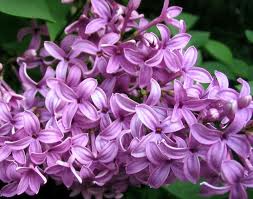 As I was driving down the road, well-past the ring of mushrooms, I wondered if anyone else had noticed them today. They do not last very long and I was having trouble resisting the urge to drive back down toward the university and photograph the rings. Working through it in my mind and knowing the only view that my iPhone could handle of the full ring was from above, I aborted the idea and gave the car some gas as I had slowed down, surely annoying other drivers. Still, I wondered if many these days even knew of the origins of fairy rings or cared very much. Then, I wondered if one day no one would know to google the term fairy ring or even notice them at all. It struck me that they were once believed to be magical and that the community at large has no time for such things. Society as a whole just doesn't believe in magic any longer......or does it?
My thoughts surfaced to the fact that today is the Summer Solstice (the solstice will occur at 7:09 EST, June 20, 2012, tonight) and that I had only seen one picture flitting around Twitter and Facebook today of Stonehenge in the sunrise or sunset of a solstice......and it was from 2008! I've posted it below this blog post - it's from the Astronomy Picture of the Day archive (APOD).
Stonehenge has a number of legends associated with it. One is that sun-worshipping people could communicate with the sun and built Stonehenge out of sacred stones to help them. Another is that there was a race of giants upon the Earth long before men and places such a Stonehenge and Easter Island show evidence of structures built by these giants.
 There are Arthurian legends as well. Then, there are the more common myths surrounding the ancient Britons' group of philosopher/poets called the Druids. According to JStor excerpts from Stuart Piggot's "The Druids and Stonehenge", there was an actual Celtic priesthood of Druids that believed in some sort of immortality and the transmigration of souls. They had rituals fairly often. Druids did also practice human sacrifice in some cases and they performed ceremonies of all kinds outside in circles of standing stones, the largest and most important of which was Stonehenge.
"Archaeologists have found four, or possibly five, large Mesolithic postholes (one may have been a natural tree throw), which date to around 8000 BC, beneath the nearby modern tourist car-park" (wiki)
Ok that's just cool. Anyway, the point........is that many people barely consider legends anymore. How often do you think of fairy rings, solstice magic, sacred rituals, other worlds and souls transforming? How often do we feel the magic of the sun? More often, we feel the heat of it here in NOLA.
I will go ahead and say it now: I much prefer a world with elements of magical things and occasional fantastic ideas that transcend what we can academically understand. I love the superstitions, legends, and myths they create. I also love sci-fi movies :-) Since I often notice unusual things and am distracted by them, taking time to ponder their significance has become a joy. I can remember in undergraduate college when I was walking across campus at night with a group of chattering friends on the way to the old McMaster Music Bldg at USC (THE USC, 1801), I made the whole group stop and look at the clouds passing across the full moon. They were in awe......for about five seconds. For me, however, the image has always stayed and I am perpetually in awe of the full moon. I look up at the sky.....and I do it often. I encourage you to do it as well. "Don't forget to stop and smell the roses" as they say. Perhaps it's the inner amateur photographer in me that captures images and holds them for ponderance and perhaps too, it is the romantic in me. Long live romanticism!
Not to discount facts and figures......after all, I am a nerd, I saw a fantastic Google plus blog by the Solar Dymanics Observatory's Camilla Corona (the most awesome chicken you'll ever meet!) that was full of information to help us understand today's reasons for the season and what a solstice actually is. Check it out here and learn about today's solstice LINK HERE
Enougth rambling for now I suppose. It's time for a spinach salad. But first, here's that fantastic summer solstice image to which I referred earlier:

Sunrise Solstice at Stonehenge
Credit & Copyright: Max Alexander, STFC, SPL

My thoughts surfaced to the fact that today is the Summer Solstice (the solstice will occur at 7:09 EST, June 20, 2012, tonight) and that I had only seen one picture flitting around Twitter and Facebook today of Stonehenge in the sunrise or sunset of a solstice......and it was from 2008! I've posted it below this blog post - it's from the Astronomy Picture of the Day archive (APOD).
Stonehenge has a number of legends associated with it. One is that sun-worshipping people could communicate with the sun and built Stonehenge out of sacred stones to help them. Another is that there was a race of giants upon the Earth long before men and places such a Stonehenge and Easter Island show evidence of structures built by these giants.

"Archaeologists have found four, or possibly five, large Mesolithic postholes (one may have been a natural tree throw), which date to around 8000 BC, beneath the nearby modern tourist car-park" (wiki)
Ok that's just cool. Anyway, the point........is that many people barely consider legends anymore. How often do you think of fairy rings, solstice magic, sacred rituals, other worlds and souls transforming? How often do we feel the magic of the sun? More often, we feel the heat of it here in NOLA.
I will go ahead and say it now: I much prefer a world with elements of magical things and occasional fantastic ideas that transcend what we can academically understand. I love the superstitions, legends, and myths they create. I also love sci-fi movies :-) Since I often notice unusual things and am distracted by them, taking time to ponder their significance has become a joy. I can remember in undergraduate college when I was walking across campus at night with a group of chattering friends on the way to the old McMaster Music Bldg at USC (THE USC, 1801), I made the whole group stop and look at the clouds passing across the full moon. They were in awe......for about five seconds. For me, however, the image has always stayed and I am perpetually in awe of the full moon. I look up at the sky.....and I do it often. I encourage you to do it as well. "Don't forget to stop and smell the roses" as they say. Perhaps it's the inner amateur photographer in me that captures images and holds them for ponderance and perhaps too, it is the romantic in me. Long live romanticism!
Not to discount facts and figures......after all, I am a nerd, I saw a fantastic Google plus blog by the Solar Dymanics Observatory's Camilla Corona (the most awesome chicken you'll ever meet!) that was full of information to help us understand today's reasons for the season and what a solstice actually is. Check it out here and learn about today's solstice LINK HERE
Enougth rambling for now I suppose. It's time for a spinach salad. But first, here's that fantastic summer solstice image to which I referred earlier:

Sunrise Solstice at Stonehenge
Credit & Copyright: Max Alexander, STFC, SPL
Sunday, May 27, 2012

Wednesday, May 16, 2012
New Orleans Summer Chorus 2012
YAY! I have finally had time to plan the
2012 New Orleans Summer Chorus! :-) This year's NOSC will be from Tuesday, June 4 to Tuesday, July 10th. It's a short one so I envision lighter repertoire, but will plan to include some Baroque and/or Classical selections. I always love working with this group. They really want to sing and it's so much fun! My MM student in Conducting, Ms. Tory Gordon, will also be conducting and our pianists are: Jieun Yun and Natalie True. Here is a picture of our flyer. (I converted PDF to JPG by using Zamzar. It took about 3 seconds and was free.)

2012 New Orleans Summer Chorus! :-) This year's NOSC will be from Tuesday, June 4 to Tuesday, July 10th. It's a short one so I envision lighter repertoire, but will plan to include some Baroque and/or Classical selections. I always love working with this group. They really want to sing and it's so much fun! My MM student in Conducting, Ms. Tory Gordon, will also be conducting and our pianists are: Jieun Yun and Natalie True. Here is a picture of our flyer. (I converted PDF to JPG by using Zamzar. It took about 3 seconds and was free.)

Tuesday, May 15, 2012
Places I've Been!
After my first "retro-post" covering my trip to South Korea in 2010, I began to wonder exactly how many times I have traveled outside of the United States. While I have always had an acute philosophical sense of time passing, Life still sort of slips up on me at times. Perhaps it does to us all. I was filing and organizing things in the music office at St. Paul's over the weekend with some lovely choir ladies and chatting with them at lunch about travels we'd had and that we wanted to make. I have been a great many places, but there are tons more I would love to explore! A partial list of those will probably be my next post. Here, there are a few details and some memorable stories, but the rest is just a list! :-)
Most of my trips have been choral performance tours, choral and orchestral workshops, and dissertation-related studies. Many of these have been reduced, partially-funded, and in the case of the England cathedral residencies: fully-funded. Sometimes, I've stayed with families and sometimes solo. I am very lucky indeed. I have also planned and penny-pinched for the rest :-) I always think of travel as part of the School of Life and as I like school..........and work in a university...........I need to continue to travel.........always..........wouldn't you say? :-)
 1990 Germany & Austria This was a fabulous two-week, packed performance tour with the Charleston Symphony Singers Guild (Emily Remington, conductor). It was my very first trip out of the country and it completely changed my life! I had gotten my first job in high school to be able to help raise money for myself to go and my parents funded the rest as a graduation present. Some of the cities we visited and sang in included: Mannheim, Heidelberg, Frankfurt, Kempten, Vienna, Salzburg (as part of the Salzburg Music Festival w/ Beethoven’s Choral Fantasy), Innsbruck, Hall im Tirol, Ulm, Friedrichshafen, Lindau, Augsburg, the amazing Wieskirche, and Munich. Some of my favorite memories are from Kempten and Ulm.
When we arrived in Kempten, I remember we were exhausted and it was late in the afternoon. I think everybody took showers and naps. When I awoke, it was evening twilight and chilly. I leaned out of our window onto the small town square below and just took a deep breath of the fresh air. As I looked out into the quiet and calm scene, a noise came from a small door on the side of the church. A little old man walked slowly across the square and took out a giant set of keys. He opened a box on the side of the stone wall and made a turn with his hand. Then, one by one, tiny hanging bulbs began to light.....slowly, until they lit up a string of lights around the square. The little man watched them, one by one, as I was watching, and when everything was lit, he closed the box and walked away. It was a beautiful, peaceful moment.
In Ulm, we were visiting the Ulm Minster, which has the tallest spire in all of Europe. It was about closing time and our choir began to sing. We performed "Holy, Holy, Holy" by Maxcine Woodbridge Posegate. It wasn't a very difficult piece, or a known pinnacle of choral literature, but the stacked chords and continuous dynamic intensity made for a moment of glory and it is one of my very favorite sacred pieces. Everyone stopped to hear us. I had never been in a place like this before and never imagined music could feel that alive in the very air we breathed. It was astounding and I was forever struck with a fever for sacred choral music written for such spaces!
 1995 Poland & the Czech Republic with the Emory University Choir, where I had just finished my Masters degree in conducting. We began our tour in Prague for about four days. I loved the pedestrian places in Praha and the bridges. The Industrial Revolution had not been good to the face of the city and its environs, but it was still georgeous. I also loved Wenceslaus Square and the street musicians. Our group took a train from Prague to the beautiful Liberec where we observed a choir rehearsal and performed. Then, on to Czestochowa to see The Black Madonna at the Jasna Gora Monastery. through the Tatra Mountains (they were SO BEAUTIFUL!!!!) to Krakow, Poland. We visited Auschwitz the next day and I was completely overwhelmed. It was raining, cold, and dreary. Being in such a dreaded place of death and seeing what took place there was chilling. We took an overnight train back to Prague.
 1996 France, Austria, Germany (stayed at a dear friend's apartment and had a blast while they were there and then took care of their place while they were away). We visited Freiburg and the Schwartzwald. After my visit, I took trains back through Switzerland & Germany to Austria to meet the USC choir for their Austria/Germany tour.
Most of my trips have been choral performance tours, choral and orchestral workshops, and dissertation-related studies. Many of these have been reduced, partially-funded, and in the case of the England cathedral residencies: fully-funded. Sometimes, I've stayed with families and sometimes solo. I am very lucky indeed. I have also planned and penny-pinched for the rest :-) I always think of travel as part of the School of Life and as I like school..........and work in a university...........I need to continue to travel.........always..........wouldn't you say? :-)

When we arrived in Kempten, I remember we were exhausted and it was late in the afternoon. I think everybody took showers and naps. When I awoke, it was evening twilight and chilly. I leaned out of our window onto the small town square below and just took a deep breath of the fresh air. As I looked out into the quiet and calm scene, a noise came from a small door on the side of the church. A little old man walked slowly across the square and took out a giant set of keys. He opened a box on the side of the stone wall and made a turn with his hand. Then, one by one, tiny hanging bulbs began to light.....slowly, until they lit up a string of lights around the square. The little man watched them, one by one, as I was watching, and when everything was lit, he closed the box and walked away. It was a beautiful, peaceful moment.
In Ulm, we were visiting the Ulm Minster, which has the tallest spire in all of Europe. It was about closing time and our choir began to sing. We performed "Holy, Holy, Holy" by Maxcine Woodbridge Posegate. It wasn't a very difficult piece, or a known pinnacle of choral literature, but the stacked chords and continuous dynamic intensity made for a moment of glory and it is one of my very favorite sacred pieces. Everyone stopped to hear us. I had never been in a place like this before and never imagined music could feel that alive in the very air we breathed. It was astounding and I was forever struck with a fever for sacred choral music written for such spaces!
1990 England Salisbury Cathedral residency w/ Trinity Episcopal Cathedral choir in Columbia, SC, directed by John Haney. A small group took a van to Cardiff, Wales afterward, 1990 This trip was less than a week after my return from the above Austria/Germany trip! We sang evensong every day and stayed in the boychoir house. I remember that they had what I would call "straw ticks" for beds and there were a few pencil drawings behind a few of them. One of my favorite memories is of us sitting on the grass outside Salisbury cathedral and looking up at the enormous stone facades, lit by starlight and spotlghts around the side. It was a special and rare experience. Another memory is walking alongside the Avon river (Hampshire). The cathedral staff had provided bag lunches for us and inside were boiled hotdog sandwiches with butter. The ducks were very excited that day at their unexpected feast. Below is a famous painting of Salisbury Cathedral by John Constable (1776-1837).
 1992 England St. Paul’s Cathedral residency with Trinity Episcopal in Columbia, SC 1992 St. Paul's was amazing!! Getting to spend extra time in the building and below it was a treasured experience as was singing evensongs during the week and mass on Sunday. It was on this trip that I began to enjoy organ concerts and repertoire. We got to see partsof the cathedral gthat ordinary tourists do not see. During this trip, I finally saw The Phantom of the Opera and Cats. I also discovered English cider and that I liked it.....a lot!
 1992 England St. Paul’s Cathedral residency with Trinity Episcopal in Columbia, SC 1992 St. Paul's was amazing!! Getting to spend extra time in the building and below it was a treasured experience as was singing evensongs during the week and mass on Sunday. It was on this trip that I began to enjoy organ concerts and repertoire. We got to see partsof the cathedral gthat ordinary tourists do not see. During this trip, I finally saw The Phantom of the Opera and Cats. I also discovered English cider and that I liked it.....a lot!
 1995 Poland & the Czech Republic with the Emory University Choir, where I had just finished my Masters degree in conducting. We began our tour in Prague for about four days. I loved the pedestrian places in Praha and the bridges. The Industrial Revolution had not been good to the face of the city and its environs, but it was still georgeous. I also loved Wenceslaus Square and the street musicians. Our group took a train from Prague to the beautiful Liberec where we observed a choir rehearsal and performed. Then, on to Czestochowa to see The Black Madonna at the Jasna Gora Monastery. through the Tatra Mountains (they were SO BEAUTIFUL!!!!) to Krakow, Poland. We visited Auschwitz the next day and I was completely overwhelmed. It was raining, cold, and dreary. Being in such a dreaded place of death and seeing what took place there was chilling. We took an overnight train back to Prague.
 1996 France, Austria, Germany (stayed at a dear friend's apartment and had a blast while they were there and then took care of their place while they were away). We visited Freiburg and the Schwartzwald. After my visit, I took trains back through Switzerland & Germany to Austria to meet the USC choir for their Austria/Germany tour.
England Yorkminster cathedral residency with Trinity Episcopal in Columbia, SC. This trip was a blast because several different Trinity choir generations mixed for the trip and I had friends from two different degree programs! We stayed in the stable house, where the jockeys stayed, about a mile and a half outside the walled city of York. LOTS of Viking history here and archeological interests. I saw a hedgehog in the grass for the first time! Each night, we would go to the horse pasture after dinner and give the horses sugar cubes
:-) We took over the local pub and made a lot of friends. We also were given special seats at a service at Yorkminster and the Queen herself attended. The music was GLORIOUS! I'm going to have to dig up my picture of the Queen mother in her green hat in her car. The picture below is of the tremendous minster.


1997 Austria & Italy: USC Concert Choir (as an alum) trip, over New Year’s. It was FOUR degrees on New Year's Eve and we were on the streets of Vienna drinking champagne. At the stroke of midnight, radios and TVs on large screens broadcast the pummerin - the gigantic bell of St. Stephen's Cathedral - you can hear it at this link www.stephansdom.at Then, everyone began to dance Strauss' Blue Danube Waltz. Check out this YouTube of Ricardo Muti conducting it...interesting facial expressions. http://www.youtube.com/watch?v=woWJqKznCSc The streets were packed with people dancing, exchanging small toy pigs (it's a Viennese tradition as well to exchange Glucksbringer, or lucky charms such as these) and then toasting. Some people began to toss bottles and champagne glasses on the ground. It echoed all around and sounded as loud as fireworks.
1999 England & France: USC Jazz band and Jazz choir to London and Paris to perform Duke Ellington’s Sacred Service. We sang in Notre Dame! One funny thing (well, NOW, it's funny), was that our group went to a restaurant underground for lunch one afternoon before leaving Paris for the village of Honfleurs in Normandy. The floor had tree roots all over it and the trees were growing right up through the top floor and out above it. I ordered French onion soup because I thought "we're in France.....so I should try French onion soup..." As one of the waitresses brought our foods, she tripped. CUE slow motion - a flying, swirling, disc of hot melted cheese and onion and bread flew across the way and landed directly upon my kneecap and molded itself onto my jeans. O U C H !! I have to say that I did sort of scream because it hurt so much and was so dang HOT. The worst part was having to get back on a hot bus for hours and smelling like stank onion.


1999 Bulgaria – My first trip to this magnificent country! It was at the end of a very hard spring semester and much was going on in my life as a whole. I was actually quite down about it all, but signed up for the choral workshop through what is now the Varna International company. It was a workshop to study the choral music and historical styles of American, Bulgarian, French, and Russian music. Larry Wyatt (The USC in SC), Helene Guy (Paris Conservatoire), Boris Tevlin (Moscow Conservatory), and Marin Tchonev (Bulgaria, the choir of Morski Zvutsi) were the clinicians. I loved my experience so much that I created a proposal to teach a course the following year! In another post this summer, I will expound on my beloved Bulgaria!
2000 - Bulgaria – choral workshop, stayed to teach a week afterwards
2000 - Bulgaria – choral workshop, stayed to teach a week afterwards
2001 - Bulgaria – choral workshop, orchestral workshop, taught, then Rome afterwards
2002 - Bulgaria – orchestral workshop, taught, then Greece afterwards. After exploring Athens for two days straight, I walked to the pier and hopped on a boat to Paros for a week. I stayed in a small B&B, walked all over the island, and spent a whole day horseback riding from one end of the island to the uninhabited area on the other side and along the beach. I got BAD sunburn, but had a BLAST! :-)
2003 - Bulgaria & Scotland – I will write more on Scotland later this summer as well. I had quite an adventure. It began with my arriving in Aberdeen and staying six miles outside of the city. The next day, I walked into town, all over town, and walked back! WHEW! There was a giant cow munching grass outside my hotel (The Water Wheel) window. There were TONS of people with my EXACT same hair color in Scotland! I rented a car and spent a week driving all over northern Scotland via single track roads, crossing the Cairgnorms, and including the Isle of Skye. I got lost a few times, didn't make reservations, and almost ran out of gas. It was so much fun!!!
2004 - Bulgaria – orchestral workshop. This time, I stayed for a month, visited schools (including a folk high school in Varna), interviewed some conductors for my dissertation, and I got food poisoning about five days before I came back. I watched Ronald Reagan's funeral service from my apartment bed and ate ice chips I made from apple juice.
Bulgaria & Romania – took my students to participate in Brahms Requiem workshop. About seven of us took a van to Bucharest for a day and a half. Then, we took a train through the gorgeous Transylvanian Alps to the Medieval town of Sighishoara where Vlad Dracul was born. 2007 I will do a separate blog post on this over the summer. So....that makes THREE that I hope to remember to do!


South Korea & the DMZ - “Fam” tour, January 2010 See previous blog post! :-)
Austria & Italy - In 2010 I taught music for the UNO Innsbruck program. For three weekends, I took train trips to Italy (weekend #1 - Bressanone/Bolzano, weekend # 2 – Rovereto, weekend # 3 - Padua/Venice), and for the final weekend my friend Kavita and I went to Salzburg and had a BLAST! I hope to teach for the Innsbruck program again. I will probably blog about a little of this trip and my weekend adventures! This picture is from my glacier hike!


Brasil & Argentina – July 2011 Spent three weeks working on a book with my colleague. In Brasil, I visited Curitiba, Blumenau, Jaragua do Sul, and Iguaçu. I visited the Argentine side of Igazu and the surrounding small town. Separate post, but that one might be about photography. I had a blast! I drank espresso and red wine and LOVED them for the very first time. I also learned to make pear risotto, understand some Portuguese, and ate pine nuts as giant as Brazil nuts. I was collaborating on a book project - which will be finished THIS SUMMER with my colleague maestro Daniel Bortholossi. The "88" butterfly below is from the Argentine side of the Iguazu falls natural reserve. The falls on both side were magnificent!!!


Mexico – 6 cruises (1 self, 1 w/ friend, 1 summer, 1 Nov., 1 w/ Mom, 1 w/ Jefferson Chorale) I’ve been able to see historically significant Mayan ruins at Uxmal, Chichen Itza, and Tuluum. I've been ablt to do so many because I had the great fortune to work with a wonderful company that helps plan choir trips and festivals. They sometimes need a judge for a group, based on national standards and sometimes they needed an escort for a group and called me. I am indebted to my friend Dawn N. for these opportunities! :-)
There! So, that's all I can think of a yap about for now. Wow, now I have tons more to blog about. I think I like blogging :-) I will probably do a separate post on each one of these trips!!!!! So many terrific experiences!
Cheers!
There! So, that's all I can think of a yap about for now. Wow, now I have tons more to blog about. I think I like blogging :-) I will probably do a separate post on each one of these trips!!!!! So many terrific experiences!
Cheers!
Friday, May 11, 2012
Retro-post My Trip to S. Korea in 2010
In this "Retro blog", I would like to share my trip to South Korea in January, 2010. I think that all I did upon my return was to post one or two status updates on FB and my photo albums. This post will give lots more details of our trip and an online place to hold it! :-)
In January, 2010, I traveled to beautiful South Korea with ten choral conductors and five others on a "Fam" tour. Familiarization tours used to be fairly common for choral directors to test the waters in hopes that they would bring a choral group on the same tour with the promoting company at future time. I remember several people I know going on different Fam tours and I was always jealous of the low price and high levels of adventure they experienced. I almost missed the Korea opportunity because even though it was addressed to me, the invitation was in a pile of junk mail that had several travel advertisements and I was going through them quickly. The price was incredible and the trip itself amazing and unique....HOW could I refuse? It was all-inclusive (lodging, airfare, transportation, and some meals, etc.)
The trip was offered by the wonderful Accolades International Tours for the Arts out of Minnesota.
 Wed. Jan. 6 We all met in Chicago to board Asiana Airlines that evening for a non-stop flight to Seoul, S. Korea. It was a LOOOONG 14-hr flight! At 6:00 a.m. the next day: Annyeonghaseyo! (Hello!) we had arrived. The runway was completely white with snow and I was wondering how the pilots could even see it at all! It was also about 10 degrees that morning, a big leap from the NOLA temperatures I had left behind. Straight away, we boarded our tour bus at Incheon airport and watched the sun rise over icy lakes and trees on our way to Ansan City. Here, we attended the rehearsal of the wonderful Ansan City Choir, directed by Shin-Hwa Park. They were very good and were working on the Durufle Requiem. Mr. Park was a masterful conductor and the beautiful bel canto singing was amazing! All of us were super tired and it was very warm inside so we were struggling to stay bright-eyed :-) but we were certainly excited to be there and happy to meet the singers and Mr. Park. Later, we also got to hear the Ansan City Children's Choir. They gave us CDs of their performances and had snacks for us in a separate room where we got to speak with their board and the director.
 After a very brief hotel stop, we headed out again to see a rehearsal of the Korean Children's Choir, directed by Mr. Heecheul Kim (pictured above). They were fabulous! Mr. Park is dynamic and their sound was vibrant. That night, we had a welcome dinner with several Korean choral directors at a Korean BBQ restaurant. YUM! It was awesome and I got to try several different kinds of Kimchi. I learned that pots of various marinades of cabbage and other vegetables are buried underground for the duration of the winter to make the kimchi and that there are several hundred varieties of it! For the rest of the tour, I noticed pots in practically every backyard. My favorite kind of kimchi was one that remotely tasted like a bean chili and it was not so vinegar-y.
 A big after dinner shock was when everyone needed to head to the restrooms. After being in the nice, warm restaurant, gathered around BBQ over coals and hot soups...the restrooms were located outside a door and in another portion of the building.......that happened to be UNheated. It was ICY cold and I could see my breath. WOW and washing my hands in more icy water was not an experience I want to repeat!
 What a terrific first day!! The next day, we had the opportunity to visit the DMZ (Demilitarized Zone), the 6th Division of the ROK Army, the Peace Center, and the 2nd Infiltration tunnel. I never really thought that I would get to see these highly volatile places so I was extremely glad to be given the chance. I had the interest in seeing/observing the DMZ ever since a friend went in 2007 as part of TOPIK (Toward Peace in Korea). Later in the trip, one of our guides, Laura, told us how hard it was for so many in South Korea to live without knowing if relatives across the border were ok or in some cases, alive. Her grandparents were in North Korea. In my opinion, the whole realization of this border is traumatic and sad. It is an exercise in futility, of pride and of war. Nonetheless, I am glad that I had this chance to observe it. On the way to the DMZ, we drove through the Gangwan province and the area of Cheorwon. It was snowy and full of wildlife between the small villages and towns. I saw several different varieties of endangered cranes. They are beautiful, noble birds and are featured throughout Korean history, myth and lore since before the Silla kingdom. Cheorwon is known for its high crane population and has an annual crane festival. You could say that we were CRANING our necks to see them out of the bus windows :-) Some of the street lamps were even shaped like crane necks! Because the bus windows were frosting over on the inside from condensation, I wasn't able to get any superb pictures along the route, but here is one decent one...

The whole of Cheorwon is located at the border with North Korea so there were frequent military stops, heavily-armed gates, and lots of long, empty roads connecting poor and rather desolate small towns and farmlands.
 It was clear when we were getting close - air space was also being guarded and no fly zones were marked. We stopped at a place to use the restroom and were watched to & from the bus. I noticed that no one else was around and it was eerily quiet. I'm sure the icy temperatures helped with that, but it was still a little odd. I also suppose there are not many tourists, especially Americans, during the harsh winters. We arrived at the lower level of the Peace Center, Woljeong Station. This location can actually be used as a performance venue.
 We took a cable car up the side of the small mountain to the main building of the center. There were tons of deer down below our car and you could see a monorail coming up after us.
 Once inside, we could look out a large window onto the landscape of the border between South and North Korea. There, we could see electric fences, guard towers, and a mix of forest and small rolling hills. Funny that the Demilitarization Zone is among the most heavily militarized zones on our planet. The whole DMZ is 155 miles and now considered a wildlife habitat because rare plants and animals have been able to flourish where humans cannot due to the insanity of war. There are listening towers and hidden land mines throughout the countryside. We toured the center and then were escorted to another part of the DMZ area. Here, we were told that we could go directly to see the tunnel and that we were not to take pictures unless directed in certain areas. A tour guide met us and explained how this tunnel was twice as large as the first "Infiltration" tunnel, had three exits, and was about eight miles. The tunnels are thought to have been built to sneak an army of North Koreans into South Korea for invasion. They were masked as "coal mining tunnels". You can only visit this tunnel # 2 as part of a touring group. Initially, it was dark, damp, and COLD in there, but after we began our descent, it warmed up considerably. It was a fascinating tour and an insight into an historical and present situation that I knew very little about. I do not often think about this area of the world or this tenuous "peace" between North and South Korea and how many of us do? The recent death of North Korean dictator Kim Jong-Il in December 2011 and his third son Kim Jong Un becoming successor......has it changed North Korea's direction, outlook, humanitarianism, structure etc.? It brought the country temporarily into the political spotlight light.....just as recent news of North Korea's continuing vows to further strengthen its nuclear arsenal and defense capabilities understandably will keep it there.


 Yep, trays of delicacies and beautifully-decorated foods were brought out to each section of the long table and we all shared. It was great, but lasted a long, long time and we were all super stuffed afterwards! I tried two kinds of eel. I loved the BBQ eel. Then, I tried squid (dislike), calamari (dislike), and JELLYFISH (bland and like a rice noodle). We also tried the rice wine, Soju, and I found that this was very tasty. Our section of the table enjoyed several small bottles of it....
 After dinner and a brisk walk, we attended a fantastic performance by MISO. It was my favorite performance. This group played native Korean and Chinese instruments and we heard several different folk singers. Different members danced symbolic dances while others sang/played. The last portion of the evening was an acrobatics show. I have only seen such things at the circus. The performers were amazing! They had the audience involved and up out of their seats!!! For the next day, we visisted possible performance venues out in the suburbs of Gwachon, Ilsan (in Goyang province), and Bundang. In the afternoon, we left for Daegu and had dinner at the Grand Hotel. Daegu is a gorgeous city and is the fourth largest city in S. Korea. It has ruins of prehistoric pit-houses, agricultural fields, and megalithic burials (dolmens) and was thought to be a walled city. Today, we took a tour of the Daegu Opera House. It has four floors and seats 1,500. It's shaped like a grand piano! Afterwards,we visited the Pilgrim Mission Choir, conducted by Lee Jae-joon. This choir won the Grand Prix in the International Festival of Choirs in 2010. During the break in watching their rehearsal, we were each given the chance to introduce ourselves, tell about our jobs and schools, and to say something about choral music. Then, one of the American conductors, Brady Allred from Utah, worked a piece with them. Afterwards, we had a grand reception and were able to interact with the singers and lots of Korean choral conductors who had come to meet us. It was a marvelous time, but a little overhwelming and humbling that they had come to meet and talk with us!


 That was SO SWEET of the whole group! I had a blast and met some fantastic people. I also recommend Accolades very highly. They were professional, organized, and terrific hosts. They also have THE connections in Korea and worked hand in hand with the Ministry of Tourism. Korea is an amazing country and its people are smart, gracious, and hospitable

Here are some links to my Facebook albums if you're interested in seeing more pictures of my adventure in South Korea:
In January, 2010, I traveled to beautiful South Korea with ten choral conductors and five others on a "Fam" tour. Familiarization tours used to be fairly common for choral directors to test the waters in hopes that they would bring a choral group on the same tour with the promoting company at future time. I remember several people I know going on different Fam tours and I was always jealous of the low price and high levels of adventure they experienced. I almost missed the Korea opportunity because even though it was addressed to me, the invitation was in a pile of junk mail that had several travel advertisements and I was going through them quickly. The price was incredible and the trip itself amazing and unique....HOW could I refuse? It was all-inclusive (lodging, airfare, transportation, and some meals, etc.)
The trip was offered by the wonderful Accolades International Tours for the Arts out of Minnesota.
 Wed. Jan. 6 We all met in Chicago to board Asiana Airlines that evening for a non-stop flight to Seoul, S. Korea. It was a LOOOONG 14-hr flight! At 6:00 a.m. the next day: Annyeonghaseyo! (Hello!) we had arrived. The runway was completely white with snow and I was wondering how the pilots could even see it at all! It was also about 10 degrees that morning, a big leap from the NOLA temperatures I had left behind. Straight away, we boarded our tour bus at Incheon airport and watched the sun rise over icy lakes and trees on our way to Ansan City. Here, we attended the rehearsal of the wonderful Ansan City Choir, directed by Shin-Hwa Park. They were very good and were working on the Durufle Requiem. Mr. Park was a masterful conductor and the beautiful bel canto singing was amazing! All of us were super tired and it was very warm inside so we were struggling to stay bright-eyed :-) but we were certainly excited to be there and happy to meet the singers and Mr. Park. Later, we also got to hear the Ansan City Children's Choir. They gave us CDs of their performances and had snacks for us in a separate room where we got to speak with their board and the director.


 Once inside, we could look out a large window onto the landscape of the border between South and North Korea. There, we could see electric fences, guard towers, and a mix of forest and small rolling hills. Funny that the Demilitarization Zone is among the most heavily militarized zones on our planet. The whole DMZ is 155 miles and now considered a wildlife habitat because rare plants and animals have been able to flourish where humans cannot due to the insanity of war. There are listening towers and hidden land mines throughout the countryside. We toured the center and then were escorted to another part of the DMZ area. Here, we were told that we could go directly to see the tunnel and that we were not to take pictures unless directed in certain areas. A tour guide met us and explained how this tunnel was twice as large as the first "Infiltration" tunnel, had three exits, and was about eight miles. The tunnels are thought to have been built to sneak an army of North Koreans into South Korea for invasion. They were masked as "coal mining tunnels". You can only visit this tunnel # 2 as part of a touring group. Initially, it was dark, damp, and COLD in there, but after we began our descent, it warmed up considerably. It was a fascinating tour and an insight into an historical and present situation that I knew very little about. I do not often think about this area of the world or this tenuous "peace" between North and South Korea and how many of us do? The recent death of North Korean dictator Kim Jong-Il in December 2011 and his third son Kim Jong Un becoming successor......has it changed North Korea's direction, outlook, humanitarianism, structure etc.? It brought the country temporarily into the political spotlight light.....just as recent news of North Korea's continuing vows to further strengthen its nuclear arsenal and defense capabilities understandably will keep it there.
The second Infiltration tunnel was very deep and the hardest part was climbing back up the slipery and steep steps. I had a lot of trouble, BUT I made it. They let me take a picture here because it was a triumph that I made it back up. My legs were jelly for the rest of the afternoon!

On the way back to our hotel, we stopped and were able to visit with a family inside their home. For choral tours, the Korean directors work with Accolades to have students staying in homes for a few days while they are on tour. The family was so nice and they had laid out snacks and teas for our group. Later that evening, we had dinner together and were able to meet the reknowned Hak Won Yoon of the Incheon City Chorale. He is a legend! His choirs ROCKED the house at the national ACDA convention in 2009 and he is both a famous teacher and clinician. Here's a YouTube of one of his choir performances of a cool piece called "Eight Laughters":

It was a tiny little restaurant, but we all took turns talking to him and sitting together. He is SO NICE and has a good sense of humor. He also was patient with all of us as we all wanted pictures with him.
After dinner, we got to attend a performance of NANTA, the amazing performing chefs. It was HILARIOUS! I have never seen vegetables chopped so fast!
The next day was full of church visits. This was for possible venues and to also hear choirs in action. The Doore Church was our first stop.It was gigantic and featured services throughout the day. It had a choir of about 150 members. We were seated together and greeted as special guests. After this service, we attend one at the Myungsung Presbyterian Church. The director of music is Mr. Heechul Kim. This church is absolutely enormous and is the largest church in the world. I can believe it! The choir was easily 300 people. The orchestra was easily over 100 members. I heard that they have four other adult choirs, four or five children's choirs of at least 300 each and two more large professional orchestras over 100 each. We sat in special guest areas and were greeted and stood to a welcome of thunderous applause. THE WHOLE CONGREGATION SANG BEAUTIFULLY! I was impressed beyond words.

The last church we visited was the Haeorum Church with music mission pastor Hyungsoo Kim.
We had a tremendous vist with World Vision and heard their children's choir. It was here that I saw an old colleague and fellow singer from the Atlanta Symphony Chorus - Heechurl Kim, who was doing some directing with the World Vision choirs.

They were phenomenal. They presented a video of the World Vision program to us and then we were treated to a choral performance which included native Korean dances.


After this, we had a Seoul city tour and a fancy dinner with members of the Korean Ministry of Tourism and past presidents of Korean ACDA. Now, I must tell you here that I do not like certain foods and any friends reading this may have a chuckle : p but I have tried the foods I disliked....some even several times, in hopes that my tastes would change. This meal was to impress us all. It was SIXTEEN courses.
 Yep, trays of delicacies and beautifully-decorated foods were brought out to each section of the long table and we all shared. It was great, but lasted a long, long time and we were all super stuffed afterwards! I tried two kinds of eel. I loved the BBQ eel. Then, I tried squid (dislike), calamari (dislike), and JELLYFISH (bland and like a rice noodle). We also tried the rice wine, Soju, and I found that this was very tasty. Our section of the table enjoyed several small bottles of it....
 After dinner and a brisk walk, we attended a fantastic performance by MISO. It was my favorite performance. This group played native Korean and Chinese instruments and we heard several different folk singers. Different members danced symbolic dances while others sang/played. The last portion of the evening was an acrobatics show. I have only seen such things at the circus. The performers were amazing! They had the audience involved and up out of their seats!!! For the next day, we visisted possible performance venues out in the suburbs of Gwachon, Ilsan (in Goyang province), and Bundang. In the afternoon, we left for Daegu and had dinner at the Grand Hotel. Daegu is a gorgeous city and is the fourth largest city in S. Korea. It has ruins of prehistoric pit-houses, agricultural fields, and megalithic burials (dolmens) and was thought to be a walled city. Today, we took a tour of the Daegu Opera House. It has four floors and seats 1,500. It's shaped like a grand piano! Afterwards,we visited the Pilgrim Mission Choir, conducted by Lee Jae-joon. This choir won the Grand Prix in the International Festival of Choirs in 2010. During the break in watching their rehearsal, we were each given the chance to introduce ourselves, tell about our jobs and schools, and to say something about choral music. Then, one of the American conductors, Brady Allred from Utah, worked a piece with them. Afterwards, we had a grand reception and were able to interact with the singers and lots of Korean choral conductors who had come to meet us. It was a marvelous time, but a little overhwelming and humbling that they had come to meet and talk with us!
The next morning, we went to a church on the US Army base and then met with some people at the Daegu Culture and Art Center and the Keimyung Art Center. Both are state of the art theatres which house performances of all kinds for the city, region, and country.
Somewhere on the tour, and I honestly cannot remember which day, we were able to visit a homeopathic type of museum. We saw the history of healing medicines and were able to buy authentic Ginseng teas and candies. It was in a community that had tons of shops, most for a specific item to be ground, used in cooking, or used another way. I've never seen so many dried mushrooms in my life!

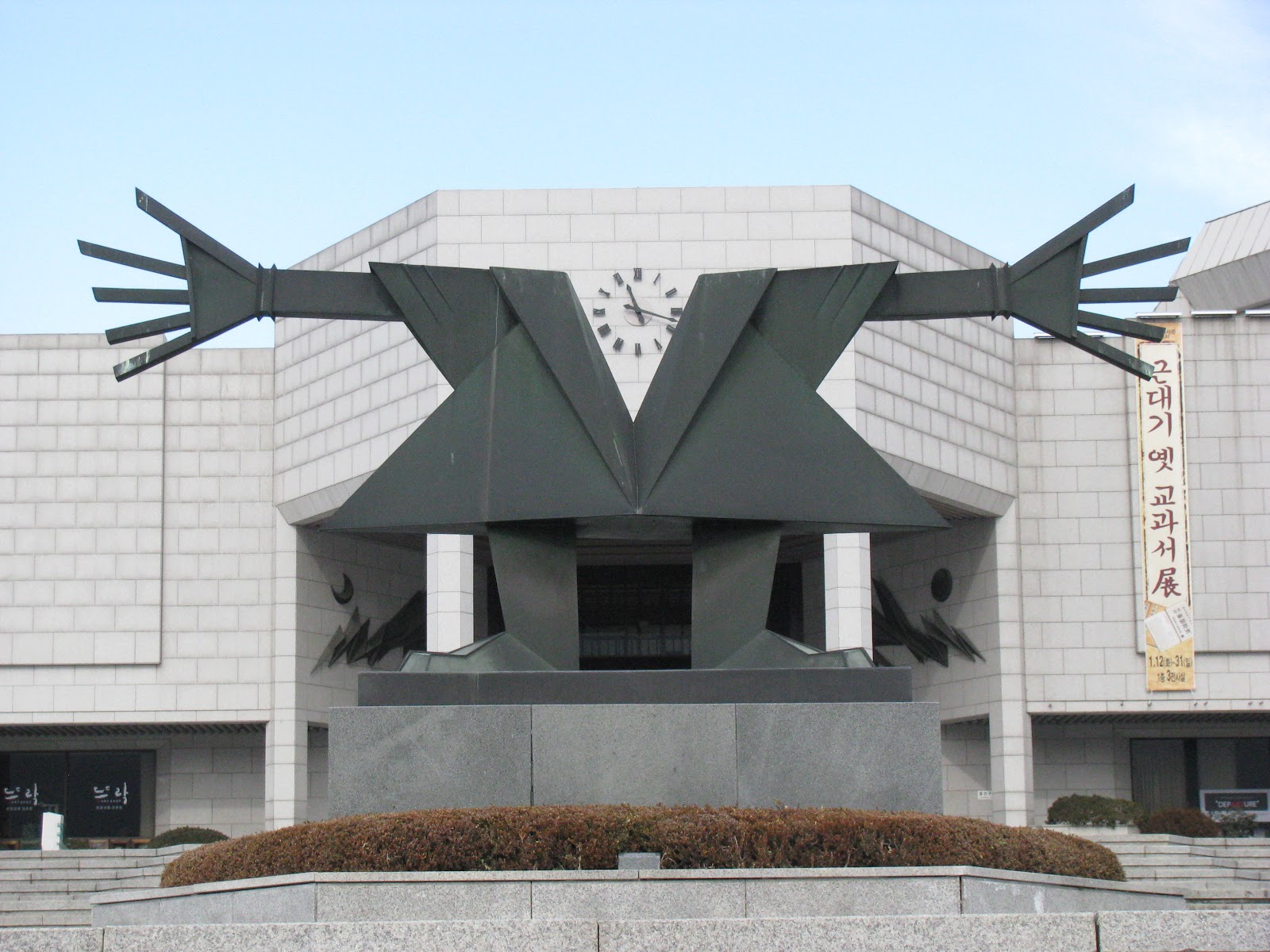
After our tours, we movd to the amazing city of Gyeongju, passing the World Cup soccer stadium along the way. An unexpected treat (it was planned, but we just didn't have it on our itinerary :-)also happened on the way: we stopped by the construction of a new performance hall which is set to be completed by 2014 in time for the World Choral Olympics. We were invited to talk with the engineers about how they were constructing it, the acoustic details, and saw a video presentation about this venue for the future. This picture is what they had set out for our visit :-)
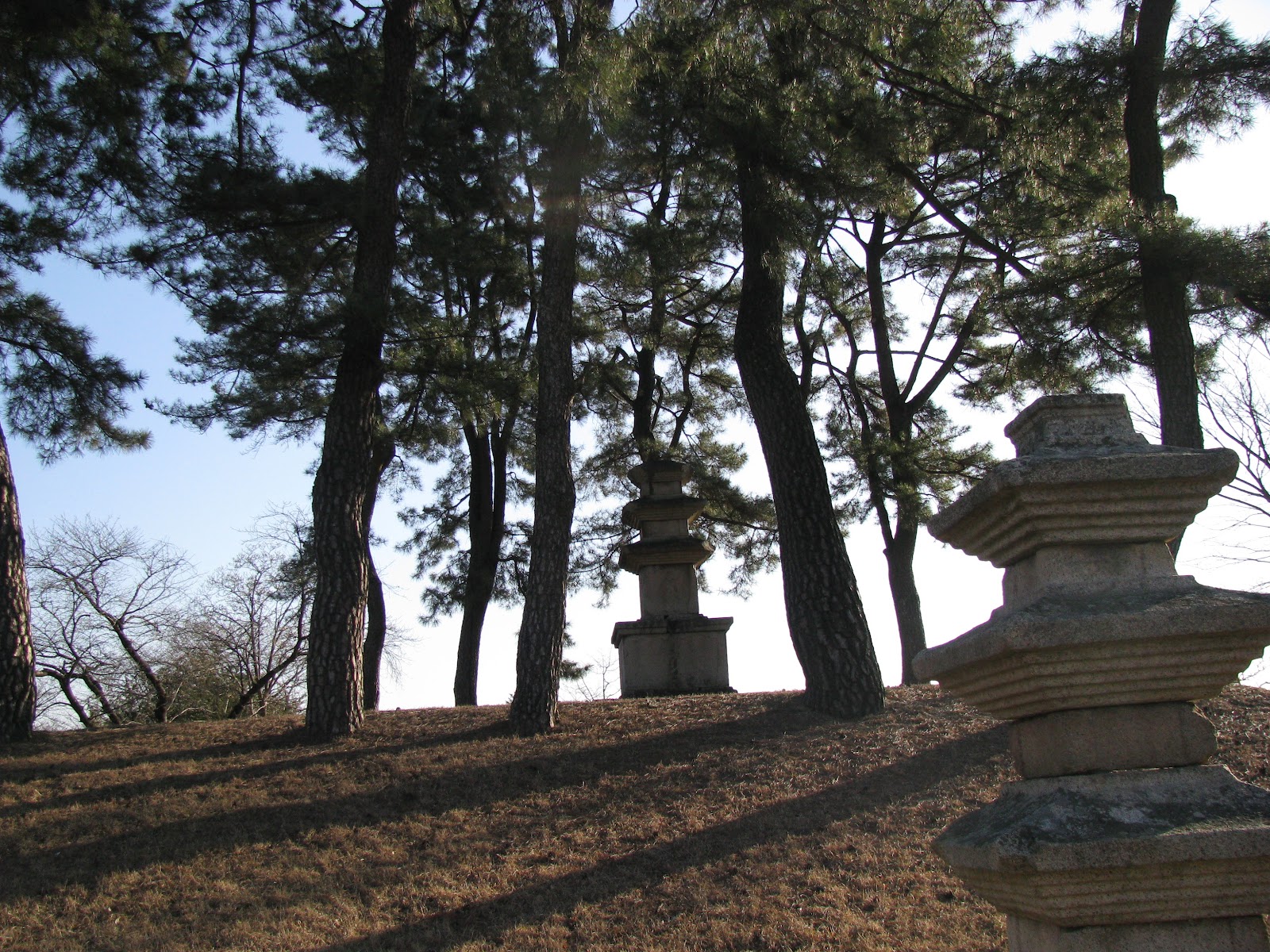
The next day was our last day, but it was one of my absolute favorites! We visited the UNESCO World Cultural Heritage sites and the EXPO center. The first site was an historic center with a wealth of Silla Kingdom history, statues, pagodas, artworks, and more! It also had a gift shop (YAY!) Gyeongju was the "capitol" of the Silla clan and has ruins of ancient temples from the 7th through the 10th century. My favorite artifact was the giant Silla bell.

Our last stop was another UNESCO site - the gorgeous Bulguksa Buddist temple on a small mountain. It was the last light of the day and the temple, adorned with designs, carvings, left-facing Buddhist swastikas, and art, gave us a sense of eternal peace.
Here is the link: http://en.wikipedia.org/wiki/Bulguksa

In the freezing 6-degree cold, we explored the grounds and then peeked into the temple. One last look at Korean countryside came with the sunset and is my favorite picture that I took while there.
Our farewell dinner was super delicious and we all sat on floor pillows. It included a Korean cake for me since it was my birthday.
 That was SO SWEET of the whole group! I had a blast and met some fantastic people. I also recommend Accolades very highly. They were professional, organized, and terrific hosts. They also have THE connections in Korea and worked hand in hand with the Ministry of Tourism. Korea is an amazing country and its people are smart, gracious, and hospitable
Subscribe to:
Posts (Atom)